
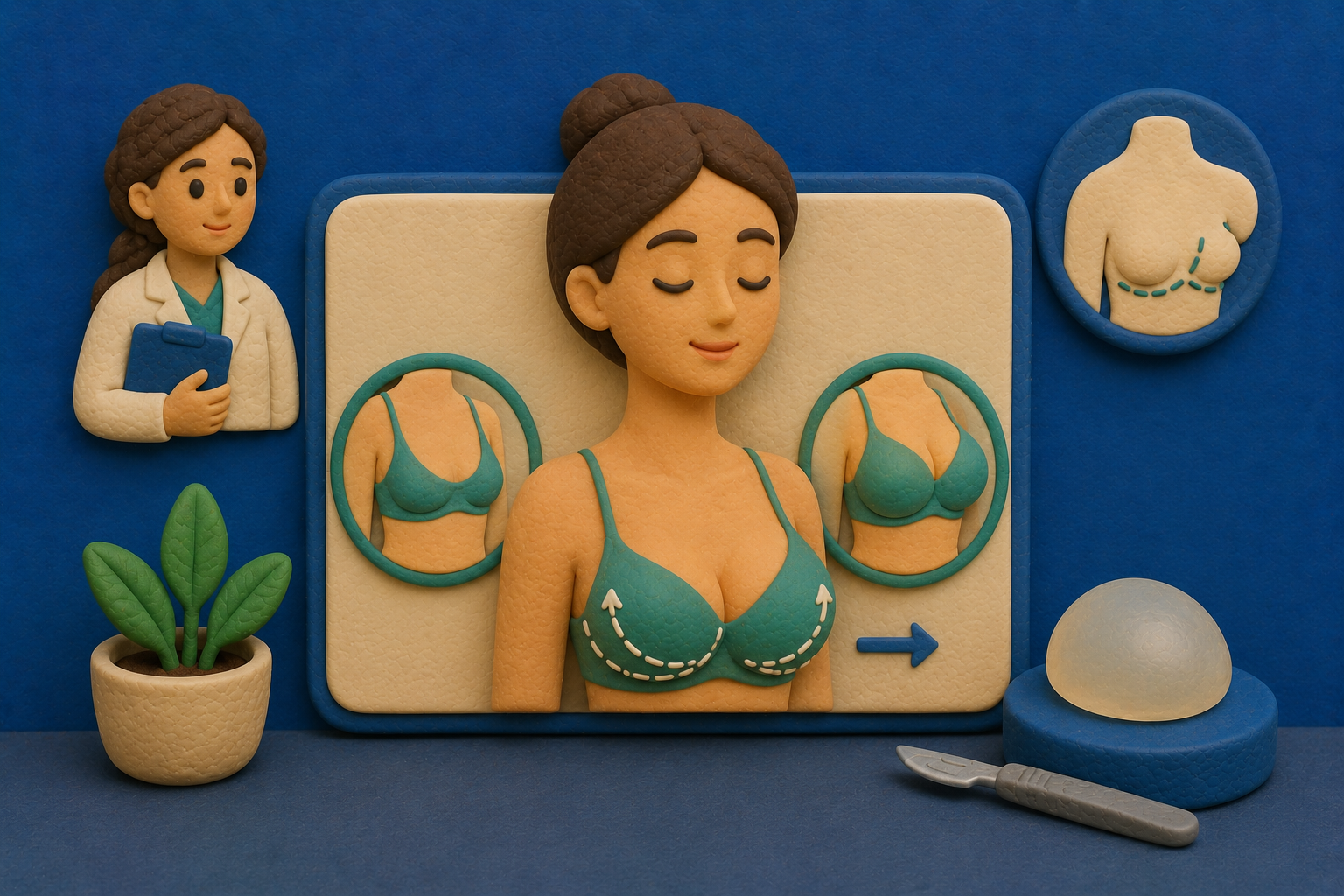
Breast augmentation is among the most requested cosmetic procedures in the world, but also one with the most variables to understand before choosing: implant type, incision site, placement and, not least, the surgeon's documented experience all affect the final result and how long it lasts.
This guide explains how breast implants are made, which surgical techniques exist, what to expect during recovery, and which questions to ask before signing a quote.
In this article
What breast augmentation is and who it's for
Breast augmentation is the plastic surgery procedure that increases breast volume through the insertion of an implant. The most common requests are increasing volume perceived as insufficient, correcting asymmetry between the two sides, or restoring volume lost after pregnancy or breastfeeding. In a different context, the same technique is also used in breast reconstruction after a mastectomy, typically as part of a team with the oncologist.
Volume increase and lifting are two different things
If the breast, beyond reduced volume, also shows significant sagging (ptosis), an implant alone will not fully resolve the issue. In these cases the surgeon may propose a breast augmentation with lift (augmentation-mastopexy), which combines an implant and a lift in the same procedure.
Breast implants: materials and surfaces
| Type | Characteristics |
|---|---|
| Cohesive silicone gel | The most widely used today: a consistency similar to natural tissue, holds its shape even if the outer shell ruptures, without deflating suddenly |
| Saline solution | Less common in modern cosmetic surgery: deflates quickly and visibly if it ruptures, but allows for smaller incisions because it is filled after insertion |
Implants also differ by surface type: a smooth surface tends to move more freely within the surgical pocket; a textured surface reduces the risk of rotation, which matters especially with anatomically (teardrop) shaped implants.
BIA-ALCL: a rare but important risk to know about
Some textured-surface implants have, in rare cases, been associated with an uncommon lymphoma known as BIA-ALCL (breast implant-associated anaplastic large cell lymphoma), recognized by international regulatory authorities. The risk remains low, but it is a point worth discussing explicitly with your surgeon, along with the surface type proposed for your case.
Shape and projection: how an implant is chosen
- Round: provides uniform fullness, including in the upper pole of the breast; if it rotates slightly within the pocket the result doesn't change, since it is symmetrical on all sides.
- Anatomical (teardrop): reproduces the breast's natural slope, with more fullness at the bottom and less at the top; if it rotates within the pocket the result can appear visibly altered, which is why it is often paired with a textured surface.
- Projection: how far the implant "projects" forward for a given base width — low, moderate or high, chosen based on chest width and the desired result.
Size is measured in cc, not bra size
Implants are measured in cubic centimeters (cc) of volume, not bra size: the same implant can look visibly different on different body types. A good consultation always includes a trial with "sizers" (trial implants) to give an indication of the result before surgery.
Surgical access routes
| Access route | Where the scar is | What to consider |
|---|---|---|
| Periareolar | Along the edge of the areola | Scar well camouflaged at the change in skin color; not always suitable for larger implants |
| Inframammary | In the crease under the breast | The most commonly used route: direct, wide access, with the scar hidden in the natural fold |
| Transaxillary | In the armpit crease | No scar on the breast itself, but a more indirect and technically more complex approach |
The choice depends on a combination of the surgeon's preference and experience, implant size, and the patient's anatomy: no single access route is universally the best.
Where the implant is placed

- Subglandular: the implant is placed above the pectoral muscle, beneath the breast gland — recovery is generally less painful, but the upper contour can look less natural in patients who start with little of their own tissue.
- Submuscular: greater coverage of the implant edge, often a more natural result for patients with little starting breast tissue, but recovery is initially more uncomfortable.
- Dual plane: an intermediate technique, today the most widely used — the upper part of the implant stays under the muscle while the lower part sits under the gland, aiming to combine the advantages of both positions.
How the procedure is performed
- Anesthesia: general, in nearly all cases.
- Duration: roughly 1-2 hours, depending on the technique and any combined correction (e.g., a lift).
- Stay: can be outpatient (day surgery) or involve one night of hospitalization, depending on the clinic and the patient's condition.
- Drains: in some cases temporary drains are placed and removed in the following days.
Recovery, week by week
| Phase | What to expect |
|---|---|
| First week | A supportive surgical bra to wear day and night, swelling and soreness, limited arm movement |
| 1-2 weeks | Possible return to non-physical work, reduced swelling and most bruising |
| 3-6 weeks | Gradual resumption of light physical activity; still avoiding sports involving the chest or overhead lifting |
| 6-8 weeks | Generally cleared for intense physical activity and contact sports, pending the surgeon's check-up |
| 3-6 months | Implants complete their settling into the pocket: the breast takes on a more natural shape and position compared to the first months |
Implants "settle" over the following months
In the first months the operated breast often looks higher and firmer than the final result: this is normal, and is due to the gradual relaxation of the tissue around the implant (a phenomenon known as drop and fluff). The definitive result should be assessed no earlier than 3-6 months.
Risks and complications to know
- Capsular contracture: the scar tissue that forms around the implant hardens and alters its shape or feel — the most common long-term complication, and one that can require further surgery.
- Implant rupture or deflation: over time, every implant carries a non-zero risk of rupture; with cohesive gel it is often silent (asymptomatic) and needs to be picked up through periodic imaging checks.
- Asymmetry or rotation of the implant, especially with anatomically shaped implants.
- Changes in nipple or surrounding skin sensitivity, temporary in most cases, permanent in a minority.
- BIA-ALCL, as noted above: a rare but recognized risk, linked in particular to some textured implants.
- Implants don't last forever: they are not guaranteed for life — over the years, a possible replacement should be factored in, even in the absence of obvious problems.
Follow-up doesn't end with the surgery
Several international health authorities recommend periodic checks over time (typically ultrasound or MRI) to verify implant integrity, even without symptoms. This is a commitment to factor in alongside the decision to have surgery, not something to discover afterward.
What the quote should include
- Implant brand and model, stated in writing — not just a generic "high-quality silicone implant."
- Manufacturer's warranty on the implant: many manufacturers offer specific warranties in case of rupture within a certain number of years.
- Surgeon's fee, operating room and anesthesia team.
- Any overnight stay, if included.
- Post-operative check-ups included, and for how long after the procedure.
The implant brand matters, as with dental implants
As with dental implants, the brand stated in writing matters for breast implants too: it allows you to verify certifications, manufacturer warranties, and the traceability of information should future checks be needed. Brands with widely recognized international certifications include, for example, Motiva, Mentor, Allergan Natrelle, Polytech and Sebbin — but the brand alone does not replace the surgeon's assessment of your specific case.
Questions to ask your surgeon
- How many breast augmentation procedures do you perform each year, and can you show cases comparable to mine?
- Which implant brand and model will you use, and why do you consider it right for my case?
- What surface type does the proposed implant have, and what does that mean for the risk of rotation or BIA-ALCL?
- Which access route and which placement do you recommend, and why?
- What warranty does the manufacturer offer on the implant?
- What happens in the event of rupture or capsular contracture over time — is there a defined process, and would there be an additional cost?