
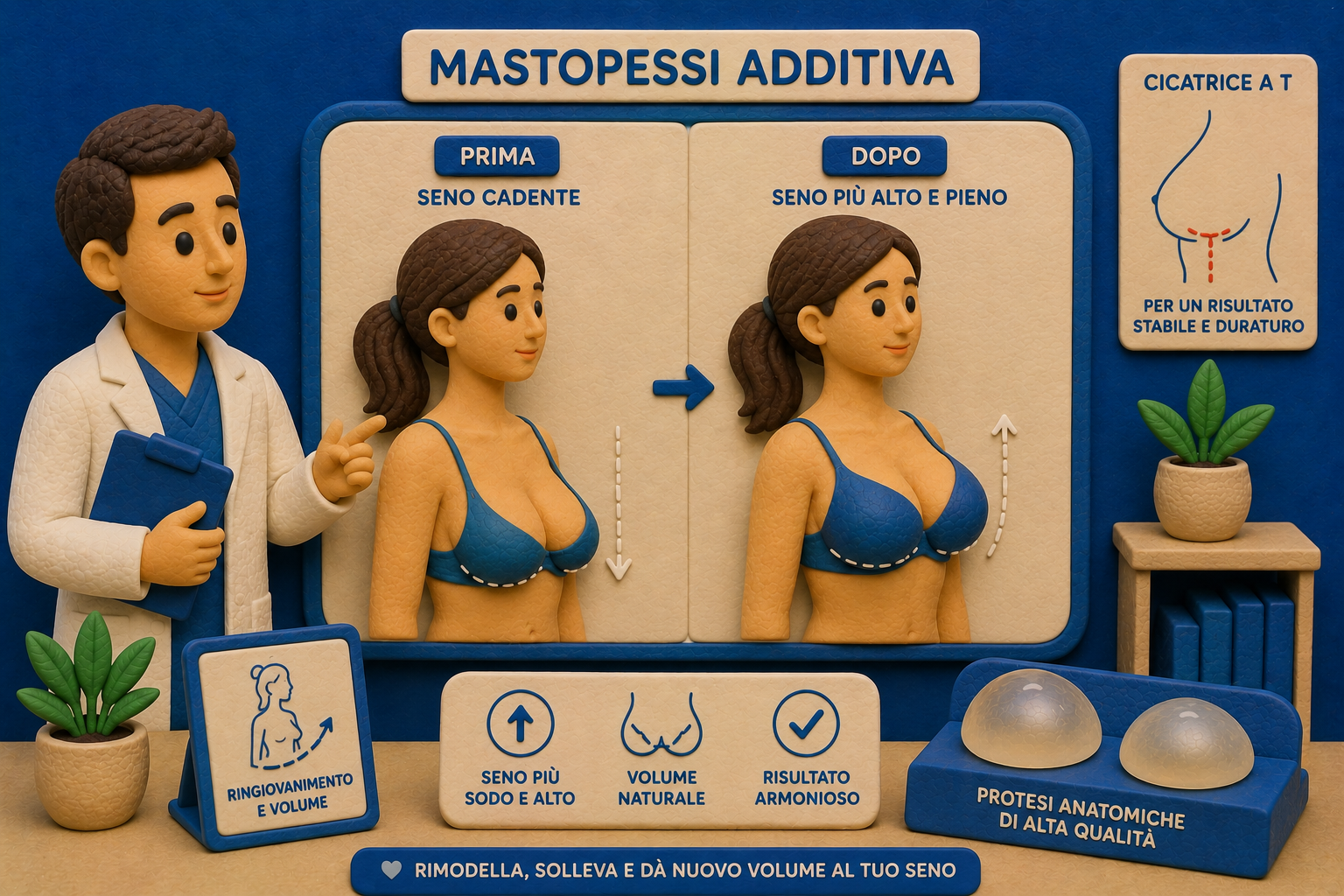
When the breast has lost volume and tone at the same time — after pregnancy, breastfeeding, or significant weight loss — an implant alone is often not enough: the tissue also needs to be lifted. That's where augmentation mastopexy comes in: a procedure that combines an implant and a lift in a single operation.
It's also one of the breast procedures with the most technical variables to understand before deciding: how much the breast has dropped, which incision is needed — including the so-called T-scar — and how skin and implant are balanced without compromising the result over time.
In this article
What augmentation mastopexy is and who it's for
Augmentation mastopexy combines two procedures into a single operation: a mastopexy, which lifts the breast by repositioning the gland, skin and areola-nipple complex higher on the chest wall, and breast augmentation, which increases its volume with an implant. It's intended for people who present both conditions together — low volume and significant sagging (ptosis) — for whom neither an implant alone nor a lift alone would deliver a satisfying result.
- After pregnancy and breastfeeding, when gland and skin have lost elasticity and volume together.
- After significant weight loss, with excess skin and reduced glandular tissue.
- Due to natural tissue aging, when loss of tone alone isn't accompanied by enough volume loss to warrant an implant on its own.
It's not the sum of two separate procedures
Even though it combines two goals, augmentation mastopexy is planned and performed as a single operation: the surgeon has to balance how much skin to remove, how much to lift the areola-nipple complex, and which implant to place — knowing that each choice affects the other two.
How breast sagging is measured
Before choosing a technique, the surgeon assesses the grade of breast ptosis — that is, how far the nipple has dropped relative to the inframammary fold (the crease beneath the breast). It's this measurement, more than subjective perception alone, that guides the choice of incision.
| Grade | Nipple position |
|---|---|
| Pseudoptosis | The nipple is still above the inframammary fold, but the gland has dropped below it — often manageable with an implant alone |
| Grade I (mild) | The nipple sits level with the inframammary fold |
| Grade II (moderate) | The nipple is below the fold, but above the lowest point of the breast |
| Grade III (severe) | The nipple is at or below the lowest point of the breast, pointing downward |
In general, the higher the grade, the more extensive the incision needs to be to correctly reposition the areola-nipple complex and remove excess skin: this is the logic behind the choice among the three techniques described in the next section.
Incision techniques: periareolar, vertical and T-shaped
There are three main incision patterns, each suited to a different degree of ptosis. The choice isn't purely aesthetic: it's a direct consequence of how much skin needs to be removed to achieve a stable lift.
| Technique | Scar shape | Indicated for |
|---|---|---|
| Periareolar (donut) | A circle around the edge of the areola | Mild ptosis or pseudoptosis, when only a small amount of tissue needs lifting |
| Vertical (lollipop) | Around the areola plus a vertical line down to the inframammary fold | Mild to moderate ptosis |
| T-shaped (or anchor) | Around the areola, a vertical line, and a line along the inframammary fold, forming an inverted T | Moderate to severe ptosis, when a significant amount of excess skin needs to be removed |
No reputable surgeon chooses the most extensive technique "just to be safe": the minimum scar sufficient to achieve a stable, lasting result is used, because a more extensive scar means more visible marking for the same goal, if it isn't genuinely necessary.
The T-scar: how it works and what to expect
The T-shaped scar (also called the "anchor scar", for its resemblance to a ship's anchor) is the most extensive of the three techniques, and becomes necessary when ptosis is moderate or severe: in these cases, the amount of skin that needs removing is such that a periareolar or vertical incision alone wouldn't be enough to redistribute it in a stable way.
- Periareolar incision: around the edge of the areola, as in the other techniques.
- Vertical incision: from the lower edge of the areola down to the inframammary fold.
- Horizontal incision: along the inframammary fold itself, where the first two incisions meet to form the inverted T.
The point where the three lines meet — at the center of the inframammary fold — is also the most delicate spot for healing: it's an area under greater tension, and it's where minor healing delays or a slightly more visible scar are most often observed, compared with the rest of the incision.
The scar matures, it doesn't disappear
In the first few months, the T-scar is red, slightly raised and clearly visible. Over the course of 12-18 months it tends to fade and flatten significantly, but it remains permanent. The inframammary fold and, for anyone who wears a bra, the vertical portion remain the parts least exposed to everyday view.
Choosing the implant in a combined procedure
In augmentation mastopexy, the implant doesn't just add volume: it also helps fill out the upper pole of the breast, often the area most depleted by ptosis. For this reason, implants with moderate projection and volumes proportionate to the available skin are generally preferred — an implant that's too large, on skin that's already lost elasticity, speeds up the loss of the result over time (a phenomenon known as "bottoming out").
Sometimes it's better to split the two procedures
When ptosis is severe or the tissue is particularly thin, some surgeons prefer to perform the lift first and, after a few months of healing, the implant in a second procedure — to reduce the risk of complications related to blood supply to the areola-nipple complex. It isn't a mandatory choice, but it should be discussed explicitly if the case is complex.
How the procedure works
- Anesthesia: general, in nearly all cases.
- Duration: roughly 2-4 hours, longer than a breast augmentation alone, due to the lift component.
- Hospital stay: an overnight stay is often planned, more frequently than with augmentation alone.
- Drains: used more often than in a straightforward breast augmentation, because a larger area of tissue is undermined.
Recovery, week by week
| Phase | What to expect |
|---|---|
| First week | Support bra worn day and night; swelling; more soreness along the incision lines than with an implant alone |
| 1-2 weeks | Removal of any drains and non-absorbable stitches; possible return to non-physical work |
| 3-6 weeks | Gradual return to light physical activity; scars are still red and actively healing |
| 6-8 weeks | Generally cleared for intense physical activity, pending the surgeon's check-up |
| 3-6 months | Implants settle and tissue softens; the scar begins to fade |
| 12-18 months | Full scar maturation, reaching its final appearance |
Specific risks and complications
In addition to the risks common to any breast procedure with implants (capsular contracture, rupture, asymmetry, BIA-ALCL — covered in detail in the guide to breast augmentation), augmentation mastopexy adds a few complications specific to combining a lift and an implant in the same procedure.
- Delayed healing at the point where the incisions meet (the center of the T), the area under the greatest tension.
- Changes in sensation or, rarely, in blood supply to the areola-nipple complex, due to greater tissue manipulation.
- Partial loss of the result over time (bottoming out), more likely if the implant chosen is disproportionate to the quality of the remaining skin.
- Asymmetry between the two sides, in either shape or nipple position, which may need correcting with a touch-up.
- More extensive and potentially more visible scarring than with breast augmentation alone, particularly with the T technique.
It's a more complex procedure, not an upgrade of breast augmentation
Combining a lift with an implant requires more technical experience than either procedure taken on its own, precisely because of the greater number of variables that need to be balanced together. It's worth asking explicitly how many combined procedures — not just straightforward breast augmentations — the surgeon has performed.
What the quote should include
- Implant brand and model, stated in writing, with the manufacturer's warranty.
- The planned incision technique (periareolar, vertical or T-shaped) and the reason it's indicated for the specific case.
- Surgeon's fee, operating room and anesthesia team.
- Any overnight stay, if planned.
- Post-operative check-ups included, and for how long after the procedure.
- Policy on revisions for the scar or any residual asymmetry once healing is complete.
Questions to ask the surgeon
- How many combined augmentation mastopexy procedures do you perform each year, not just straightforward breast augmentations?
- What grade of ptosis do I have, in your assessment, and which incision technique does that call for?
- In my case, would you recommend performing the lift and the implant in the same session, or in two separate stages?
- What implant brand and volume do you consider appropriate for the current quality of my skin?
- What happens if, after healing, the scar at the center of the T doesn't heal well?
- Are post-operative check-ups and any scar touch-up included in the price?