
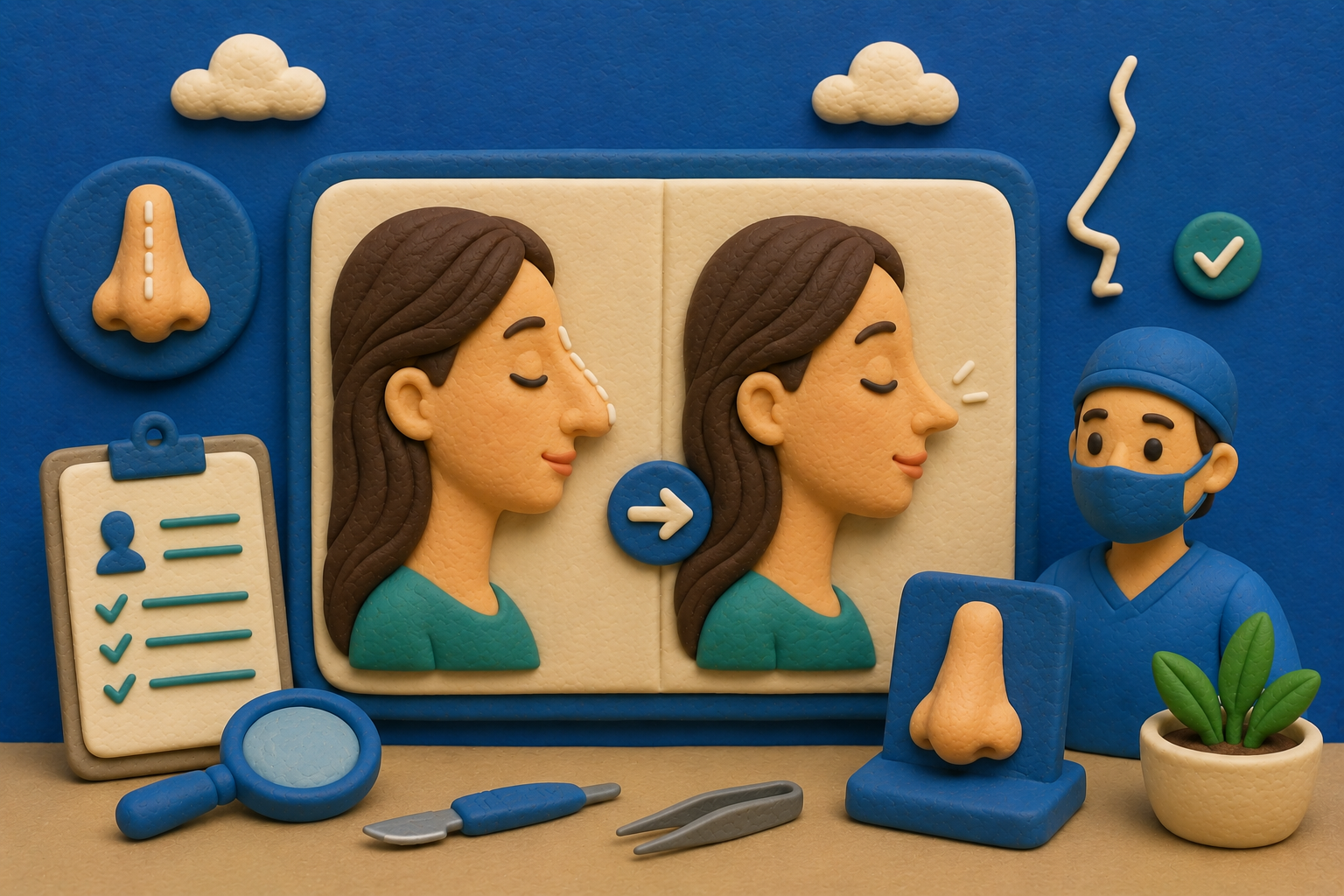
Rhinoplasty is one of the most requested cosmetic procedures, but also one of the most technically demanding: the nose is a functional organ, not just a matter of shape — its bone and cartilage structure is also involved in breathing. For this reason, more than for many other procedures, choosing the right surgeon and being clear on expectations is what separates a harmonious result from one that needs correcting.
This guide explains how the procedure works, which techniques exist, how long recovery really takes — usually much longer than people expect — and which questions to ask before signing a quote.
In this article
What rhinoplasty is and who it's for
Rhinoplasty is the plastic surgery procedure that changes the shape, size or proportions of the nose by working on its bone and cartilage structure. It generally falls into three distinct clinical situations, which are often confused with one another:
- Cosmetic rhinoplasty: corrects features perceived as disproportionate — a dorsal hump, a poorly defined tip, overly wide nostrils, visible asymmetries.
- Functional rhinoplasty (septoplasty): corrects breathing problems linked to a deviated nasal septum or collapsed nasal valves, regardless of aesthetic appearance.
- Septorhinoplasty: combines both goals in the same procedure — the most common situation for patients who have both an aesthetic and a breathing issue to correct.
The nose and breathing are connected
Even a rhinoplasty requested purely for aesthetic reasons can affect breathing, positively or negatively, because it alters internal structures involved in airflow. An experienced surgeon always assesses both aspects, even when the patient is only asking for a change in appearance.
Closed and open rhinoplasty: the two techniques
There are two main surgical approaches, which differ in how the nasal structure is accessed, not in the result that can be achieved.
| Technique | How it works | When it's used |
|---|---|---|
| Closed (endonasal) | Incisions are made entirely inside the nostrils, leaving no visible scars | More limited corrections; post-operative swelling is generally less pronounced |
| Open | A small additional incision on the columella (the tissue between the nostrils) allows the skin to be lifted so the surgeon can see the nasal structure directly | More complex corrections or revision surgery; direct visualization for the surgeon, but a minimal scar remains |
Neither technique is "better" in absolute terms: the choice depends on the complexity of the case and the surgeon's specific experience with one or the other, not on current trends.
The pre-operative consultation: what to expect
A thorough consultation is one of the most important moments in the entire process: it's where the patient's expectations are aligned with what is realistically achievable.
- Complete medical history: allergies, previous surgeries, current medications, any clotting issues.
- Examination of the nasal structure: skin, cartilage, septum, nasal valves, and assessment of any pre-existing facial asymmetry — no face is perfectly symmetrical.
- Standardized photographs from multiple angles, used as before/after reference points.
- Simulation of the expected result, when available: useful for aligning expectations, but should be treated as indicative, not a promise of the final outcome.
Be wary of anyone who guarantees a result
No serious surgeon can guarantee a result identical to a computer simulation: each patient's skin, healing process and underlying structure shape the final outcome in ways no simulation can fully predict.
How the procedure is performed
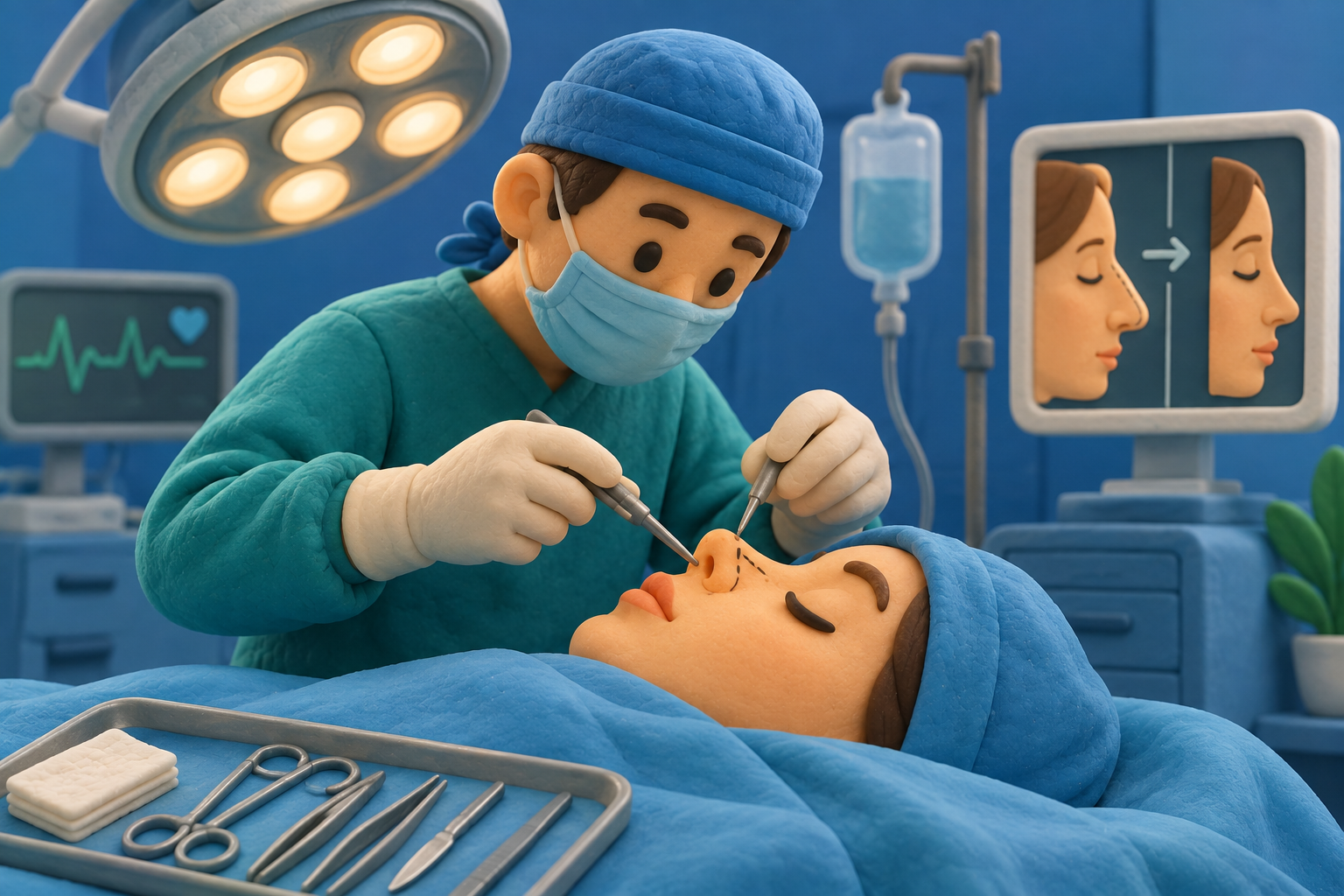
- Anesthesia: usually general; in select cases, deep sedation with local anesthesia.
- Duration: 1 to 3 hours, depending on the complexity of the case.
- Cartilage grafts: if additional material is needed for the structure, it can be taken from the septum itself, from the ear or, in more extensive cases, from rib cartilage.
- External splint: applied at the end of the procedure to protect and stabilize the new structure, removed after about a week.
- Internal nasal packing or splints: used in some cases for a few days to stabilize the septum.
Recovery, week by week
| Phase | What to expect |
|---|---|
| First week | External splint, swelling and bruising (especially around the eyes), reduced nasal breathing if packing is in place |
| 1-2 weeks | Splint removed, most visible bruising has faded, possible return to non-physical work |
| 2-4 weeks | Obvious swelling decreases significantly, but subtle residual swelling remains, not always visible to others |
| 1-3 months | Return to intense physical activity and contact sports only after the surgeon's clearance |
| 6-12 months | Residual swelling, especially at the tip, continues to subside slowly until the final result |
The final result takes patience
The nose keeps changing, in increasingly subtle ways, for 6-12 months after surgery — sometimes up to 18 months in patients with thicker skin. Judging the result in the first few weeks almost always leads to a premature assessment.
When you see the final result
A good rhinoplasty result doesn't aim for a single "perfect nose" template that fits everyone, but for a nose in harmony with the proportions of the rest of the face — which is why two patients with the same initial request can receive different surgical recommendations. Photographs and simulations help set expectations, not fix them rigidly: skin, bone structure and each patient's individual healing capacity always have the final say on the outcome.
Possible risks and complications
- Bleeding and infection, as with any surgical procedure, manageable but worth monitoring in the first few days.
- Temporary, or more rarely permanent, breathing difficulties, if the internal structure doesn't heal as expected.
- Asymmetries or minor irregularities of the tip or bridge, noticeable mainly to the touch or under raking light.
- Need for revision surgery: a share of patients (the proportion varies by case series) need a touch-up to refine the result — a figure worth asking the surgeon directly, based on their own specific track record.
- Temporary loss of sensation at the tip of the nose, which generally resolves over the following months.
Revision should only be considered after complete healing
Even if the result at a few weeks isn't fully convincing, any revision should be considered only after swelling has fully subsided — typically no sooner than 12 months after surgery.
What the quote should include
As with any procedure, the quote should be written and itemized line by line — not a single all-inclusive figure with no breakdown.
- Surgeon's fee.
- Operating room and anesthesiology team.
- Any overnight stay, if planned.
- Materials, including any cartilage grafts, splint and packing.
- Included post-operative follow-up visits, and for how long after surgery.
- Revision policy: whether a touch-up within a given period is included in the price or quoted separately.
Questions to ask your surgeon
- How many rhinoplasties do you perform each year, and can you show me before/after cases comparable to mine?
- Are you board-certified in plastic surgery, with verifiable credentials?
- Will you use an open or closed technique in my case, and why that one specifically?
- What percentage of your patients need revision surgery?
- What happens if, after complete healing, I'm not satisfied with the result?
- Are post-operative follow-up visits included in the price, and for how long?