
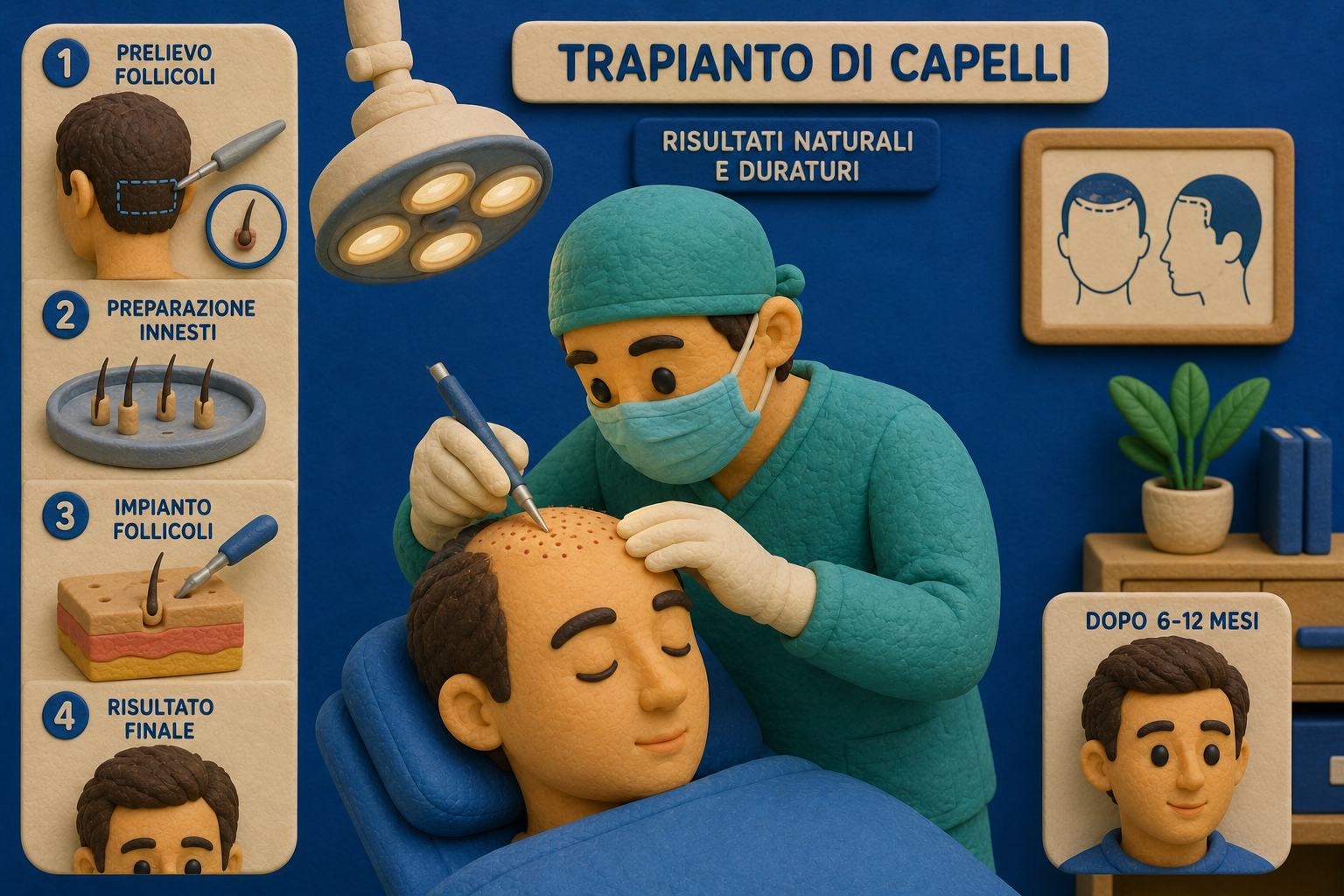
A hair transplant is one of the procedures with the most variables hidden behind an apparently simple quote: the technique used, the real number of grafts, and who actually performs the implantation — all of these affect the outcome as much as, if not more than, the final price.
This guide explains how the procedure works, the differences between FUE, FUT and DHI, how many grafts you really need depending on the area to be treated, and which questions to ask before choosing a clinic.
In this article
What a hair transplant is and why it's permanent
A hair transplant is a surgical technique that extracts hair follicles from a donor area — typically the back and sides of the head — and reimplants them in thinning or bald areas. It works because, in most cases of androgenetic alopecia, follicles in the occipital area are genetically more resistant to the action of DHT (dihydrotestosterone, the hormone responsible for the progressive miniaturization of the follicle) — and they retain this resistance even once transplanted elsewhere.
Why the donor area resists hair loss
Androgenetic alopecia doesn't affect all follicles equally: those in the occipital and lateral areas are less sensitive to DHT for genetic reasons. Once transplanted to the frontal area or the crown, they retain this trait — which is why, as a rule, they don't fall out again.
Who is a good candidate
- Stabilized or advanced-stage androgenetic alopecia (classified using the Norwood-Hamilton scale for men, Ludwig for women): the most common case, and the one with the most predictable results.
- A sufficiently dense donor area: the density and extent of the occipital and lateral zone determine how many grafts are realistically available — not just the patient's wishes.
- Realistic expectations: a transplant redistributes existing hair, it doesn't create it from nothing. It doesn't restore the density of a scalp that was never thinning.
Not suitable for every form of alopecia
In cases of active alopecia areata, diffuse or scarring alopecia, or hair loss that hasn't yet stabilized, a transplant may not be advisable or should be postponed. A trichologist/dermatologist should always confirm the diagnosis and the stability of the hair loss before proceeding.
FUE, FUT and DHI: the techniques compared
| Technique | How it works | What to consider |
|---|---|---|
| FUE (Follicular Unit Extraction) | Individual follicles are extracted one by one with a micro-punch, then reimplanted into the recipient areas | No linear scar, generally faster recovery; a longer procedure, with a practical limit on grafts per session |
| FUT (strip) | A strip of scalp is removed from the donor area and divided under a microscope into individual grafts | Allows more grafts to be harvested in a single session, but leaves a linear scar, usually covered by surrounding hair |
| DHI (Direct Hair Implantation) | A variant of FUE: follicles are implanted directly with an implanter pen, without recipient incisions prepared in advance | More precise control of angle and direction, often marketed as a premium option; procedure times are generally longer |
No technique is objectively superior to the others in every case: the choice depends on the extent of the area to be covered, the quality of the donor scalp, and the clinic's specific experience with one technique or the other.
The follicle and the hair growth cycle
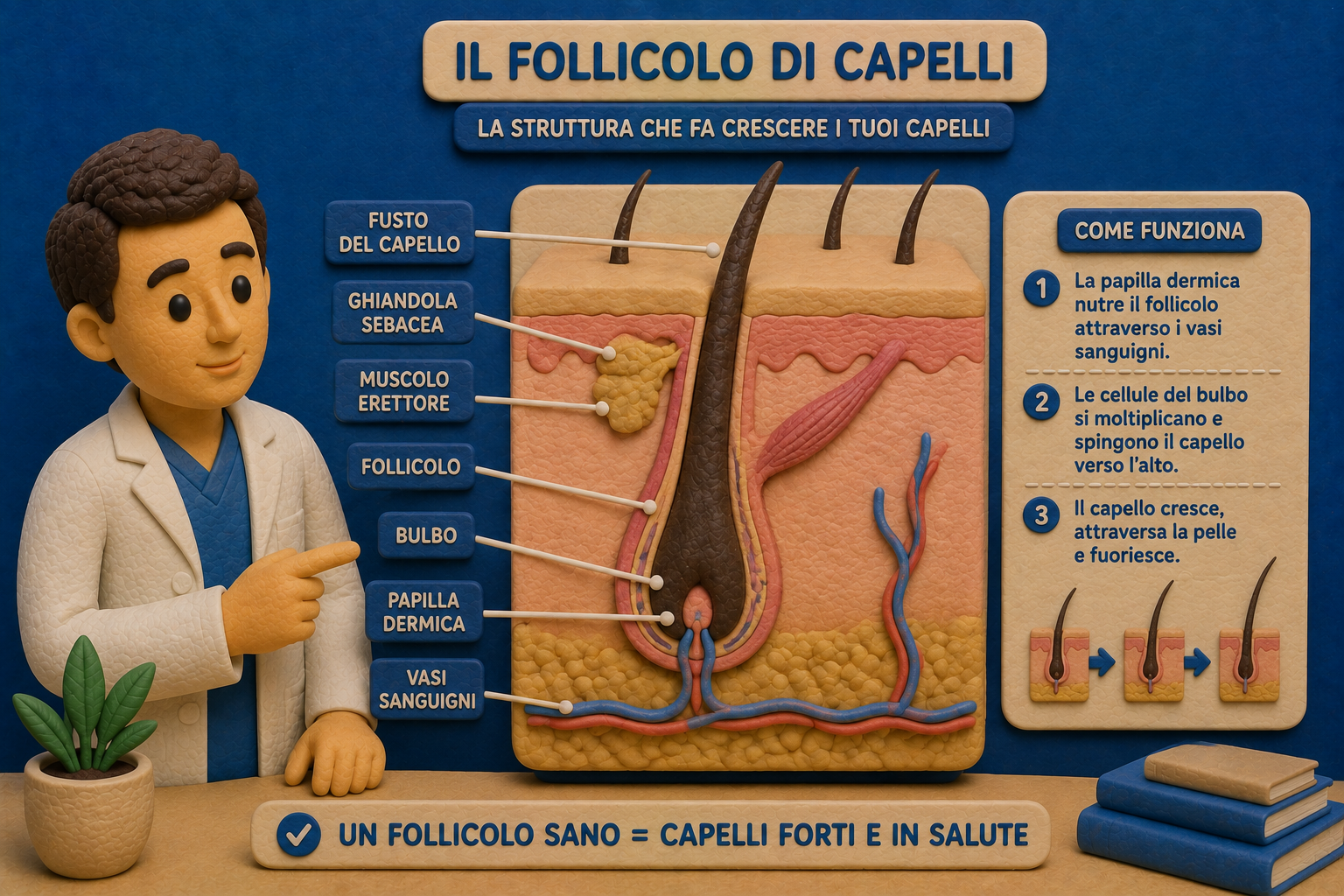
Every hair goes through a cycle with three phases: growth (anagen), transition (catagen) and rest (telogen), at the end of which it falls out and the follicle generates a new one. A transplanted follicle often enters a phase of forced dormancy soon after the procedure — the visible hair falls out — but the bulb remains alive beneath the skin and starts producing a new hair in the following months. This is the mechanism behind the phenomenon known as "shock loss", described further below.
How the procedure is performed
- Anesthesia: local, with optional light sedation for patient comfort during sessions that can last several hours.
- Duration: 4 to 8 hours, depending on the number of grafts and the technique chosen.
- Team: extraction and implantation often involve several operators working in parallel, under the surgeon's supervision.
- Sessions: in most cases a single session is enough; more extensive hair loss may require a second one, months or years later.
The post-operative course, month by month
| Phase | What to expect |
|---|---|
| First week | Small scabs in the transplanted areas, redness, possible forehead swelling in the first few days |
| 2-3 weeks | The scabs fall off; "shock loss" often begins, with the temporary shedding of most of the transplanted hair |
| 1-3 months | The scalp may look thinner than before because of shock loss: this is a normal phase, not a sign the procedure failed |
| 3-6 months | New hair starts regrowing, thin at first and progressively thicker |
| 6-12 months | Density and thickness keep improving until the final result is reached |
Shock loss is expected, not a failure
Seeing transplanted hair fall out in the first few weeks worries many patients, but it's an expected physiological step: the follicle stays alive beneath the skin and enters a new growth phase in the following months.
How many grafts you really need
| Area to be treated | Indicative grafts |
|---|---|
| Receding hairline or temple corners | 500 - 1,500 |
| Crown or extensive frontal area | 1,500 - 3,000 |
| Extensive hair loss (multiple areas combined) | 3,000 - 5,000+, often across multiple sessions |
These numbers are purely indicative: the real figure depends on the density of each patient's individual donor area, not on a standard package that's the same for everyone.
Be wary of quotes with a fixed graft count decided in advance
A serious quote comes after a direct examination (even by video call) of the donor area's density, not from a standard table offered to every patient in the same way.
Who actually performs the procedure
At many clinics, especially in hair transplant tourism, most of the session — particularly the implantation of the follicles — is carried out by specialized technicians, not directly by the surgeon, who coordinates and supervises the work. This isn't a problem in itself: experienced teams perform thousands of implantations a year with excellent results. The point is transparency: patients have the right to know in advance who will be doing what.
- Who performs the follicle extraction?
- Who performs the implantation, and how much documented experience does the team have?
- Is the surgeon present for the entire session, or only part of it?
Risks and limitations to know
- Prolonged shock loss or partial regrowth in a minority of cases.
- Visible linear scar with the FUT technique, especially with hair kept very short.
- Small dot-like scars (FUE), generally barely visible but present in the donor area.
- Folliculitis or infection in the treated areas, usually manageable with the care indicated by the clinic.
- Unnatural-looking result if the frontal hairline isn't designed carefully — a hairline that's too straight, or density that's unrealistically uniform.
- Depletion of the donor area: in cases of progressive hair loss, the donor area isn't infinite — any future sessions need to be planned with possible further natural hair loss in mind.
What the quote should include
- The number of grafts actually planned, not a generic "unlimited" package.
- The technique used (FUE, FUT or DHI) and the reason for that choice in the specific case.
- Who actually performs the extraction and implantation: the surgeon or a team of technicians.
- The number of sessions required and the cost of any additional sessions.
- Post-operative check-ups included, and for how long.
Questions to ask the clinic
- How many transplants does the clinic perform each year, and can it show cases comparable to mine in extent and hair type?
- Who actually performs the implantation, and with what documented experience?
- Which technique will you use, and why is it suited to my case?
- How many grafts are realistically available in my donor area?
- What happens if, in the future, hair loss continues to progress in untreated areas?
- Are post-operative check-ups included in the price, and for how long?