
Whether it sits on a weakened natural tooth or on top of an implant, the crown is the last piece of the treatment — the visible one, the one you chew with every day, and the one that largely determines how your smile looks. Yet it's often the line item on a quote that gets the least scrutiny, dismissed with a generic phrase like "high-quality ceramic crown."
The crown material isn't a minor detail: it changes appearance, strength, longevity and, quite often, the final price of the treatment. This guide explains what a crown is, how one placed on a natural tooth differs from one placed on an implant, and compares the most common materials — from best to worst, based on aesthetics, strength and clinical track record.
In this article
What is a dental crown
A dental crown is a covering that encases the entire visible tooth, reproducing its shape, colour and function. It's used when a natural tooth is too damaged or weakened to be rebuilt with a filling (due to extensive decay, a fracture or root canal treatment), or as the final component of a dental implant, where it completely replaces the crown of the missing tooth.
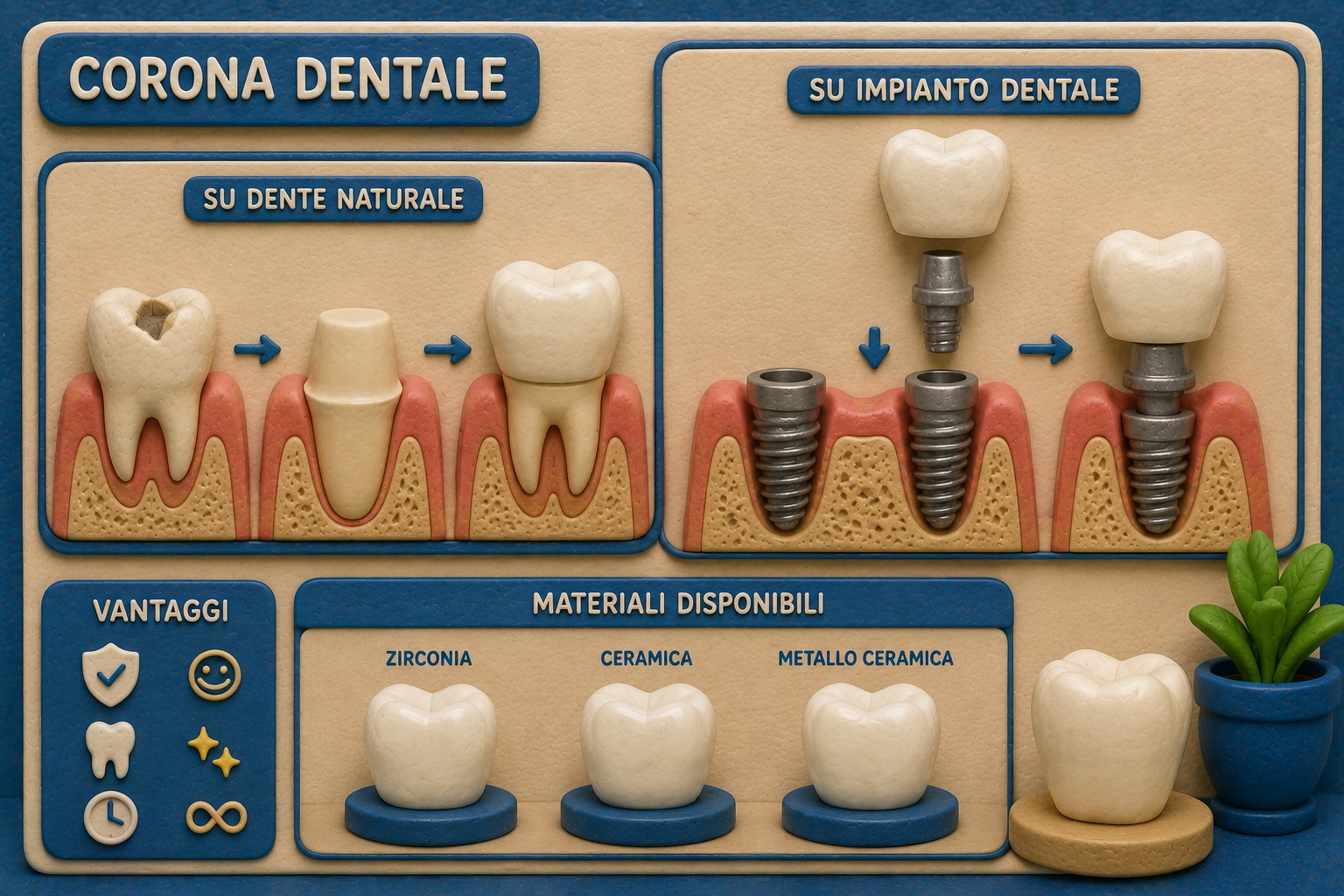
Crown on a natural tooth vs. on an implant
- Crown on a natural tooth: the tooth is filed down to make room, and the crown is then cemented or bonded onto the remaining natural stump. This is used when the original root is still healthy and salvageable.
- Crown on an implant: the crown is screwed or cemented onto the abutment connected to the titanium implant, which has fully replaced the natural root. It doesn't require "sacrificing" healthy tooth tissue, because there's no natural tooth left to work on.
In both cases, the material of the visible crown is chosen using the same criteria — aesthetics, strength, position in the mouth — described throughout the rest of this guide.
How a crown is made: the main steps
Regardless of the material chosen, making a crown follows a similar path, largely digitised today in the most modern clinics:
- Preparation: the natural tooth is filed down to make room for the crown, or the abutment is attached in the case of an implant.
- Impression: the exact shape of the prepared tooth (or abutment) and the dental arch is captured, either with a traditional silicone impression or, increasingly, with a digital intraoral scanner, which is faster and generally more precise.
- Temporary crown: while the final crown is being made, a temporary crown (often resin) is fitted to protect the tooth and preserve its appearance.
- Design and milling: with CAD/CAM technology the crown is designed on a computer and milled from a block of the chosen material, or it's crafted by hand in a dental laboratory for the more elaborate layered aesthetic work.
- Try-in and cementation: the final crown is tried in to check shape, colour and bite, then permanently cemented or screwed into place.
A digital scanner can shorten travel time
For patients travelling abroad for treatment, a clinic equipped with an intraoral scanner and in-house CAD/CAM milling can produce some crowns faster than sending the case out to an external lab — worth asking about if you only have a few days available for the trip.
Crown materials compared, from best to worst
"Best" doesn't mean the same thing in every situation: a material that's excellent for a front incisor (where aesthetics matter most) isn't necessarily the best choice for a molar (where resistance to chewing load matters most). The ranking below reflects an overall balance of aesthetics, strength and clinical track record — the sections that follow explain when each material is truly the right choice.
| Rank | Material | Aesthetics | Strength |
|---|---|---|---|
| 1 | Zirconia | Very good (excellent in modern multilayer versions) | Very high |
| 2 | Lithium disilicate (e.max) | Excellent | High |
| 3 | All-ceramic (feldspathic) | Excellent | Medium |
| 4 | Porcelain-fused-to-metal (PFM) | Fair | High |
| 5 | Composite resin | Adequate | Low |
1. Zirconia — the benchmark choice
Zirconia is today the most widely used crown material, and is generally considered the best overall compromise: it's extremely strong (suitable even for molars, where chewing load is highest), biocompatible, and in its latest-generation multilayer versions it reaches an aesthetic level very close to all-ceramic, with a translucency that mimics natural enamel well. It's also the material that makes it easiest to produce very thin crowns without compromising strength.
Not all zirconia is the same
There are first-generation zirconias, more opaque and stronger but less aesthetic, and newer multilayer zirconias, which strike a better balance between appearance and strength. It's worth asking which version is being used, especially for front teeth.
2. Lithium disilicate (e.max) — the top choice for front-tooth aesthetics
Lithium disilicate, often referred to by its commercial name e.max, is the go-to material when aesthetics are the absolute priority, typically for incisors and other front teeth visible in the smile: its translucency is the closest to natural enamel of any ceramic material. It's less resistant than zirconia to heavy chewing loads, which makes it less suited to molars or to patients with pronounced, uncontrolled bruxism.
3. All-ceramic (feldspathic)
All-ceramic (or feldspathic) material offers excellent aesthetics, comparable to or even better than lithium disilicate in skilled hands, and is also commonly used for veneers. However, it's the most fragile of the modern ceramic materials, with a higher risk of chipping or fracturing under load: for this reason it's generally reserved for single crowns in low-load areas of the mouth, rather than for extensive restorations or molars.
4. Porcelain-fused-to-metal (PFM)
Porcelain-fused-to-metal (PFM) is an older but still very common technology: an internal metal alloy structure covered with a layer of aesthetic ceramic. It's strong and relatively affordable, but has two well-known limitations: over time the gumline can show a thin grey shadow from the metal underneath, and in a minority of patients the metal alloy (especially if it contains nickel) can cause sensitivity or allergic reactions.
Always ask about the alloy composition
If you opt for a porcelain-fused-to-metal crown, it's worth asking what type of alloy is used (noble, semi-noble or base) — it affects both the cost and the risk of allergic reactions over time.
5. Composite resin
Composite resin is the most affordable material and the easiest to repair, but also the least durable: it tends to discolour and wear down faster than other materials, and is more prone to fracturing under sustained load. It's a reasonable solution for a temporary crown while the final one is being made, but should be considered with caution as a permanent solution, especially on back teeth.
How to choose the right material
Rather than looking for "the best material" in absolute terms, it makes more sense to reason by criteria:
- Tooth position: on front teeth it's worth prioritising aesthetics (e.max, all-ceramic, multilayer zirconia); on molars it's worth prioritising strength (zirconia, PFM).
- Bruxism: people who grind their teeth should lean toward high-strength materials (zirconia) and avoid more fragile ceramics where possible.
- Known metal allergies: these rule out PFM crowns with base-metal alloys, in favour of all-ceramic solutions.
- Budget: resin is the cheapest but least durable option; zirconia and e.max cost more but reduce the risk of having to redo the crown down the line.
- Number of crowns and overall load: in extensive restorations (such as All-on-4 or All-on-6) the choice of prosthesis material follows the same logic described here for resin and zirconia in our guide to All-on-4 and All-on-6.
Lifespan and maintenance
| Material | Indicative lifespan |
|---|---|
| Zirconia | 15-20+ years |
| Lithium disilicate (e.max) | 10-15 years |
| All-ceramic | 8-12 years |
| Porcelain-fused-to-metal | 10-15 years |
| Composite resin | 3-7 years |
These are indicative ranges, not guarantees: actual lifespan depends on oral hygiene, bruxism, tooth position and the quality of the work, as well as on the material itself. Regular check-ups and good interdental hygiene remain the single most important factor for the longevity of any crown, whatever material is chosen.
Indicative costs
Prices vary widely by country, clinic and individual case, but broadly the cost scale follows the same hierarchy as the table above: resin is the cheapest, zirconia and e.max the most expensive, with PFM sitting somewhere in between. As with implants, the crown material should always be specified in writing on the quote, not described generically as "high-quality ceramic."
Questions worth asking
- What material are you proposing for this tooth, and why is it suited to its position?
- If it's zirconia, is it a multilayer or a first-generation version?
- If it's porcelain-fused-to-metal, what type of alloy is used?
- How long does this material typically last, in your clinical experience?
- What happens if the crown chips or fractures after I've returned home from the trip?