
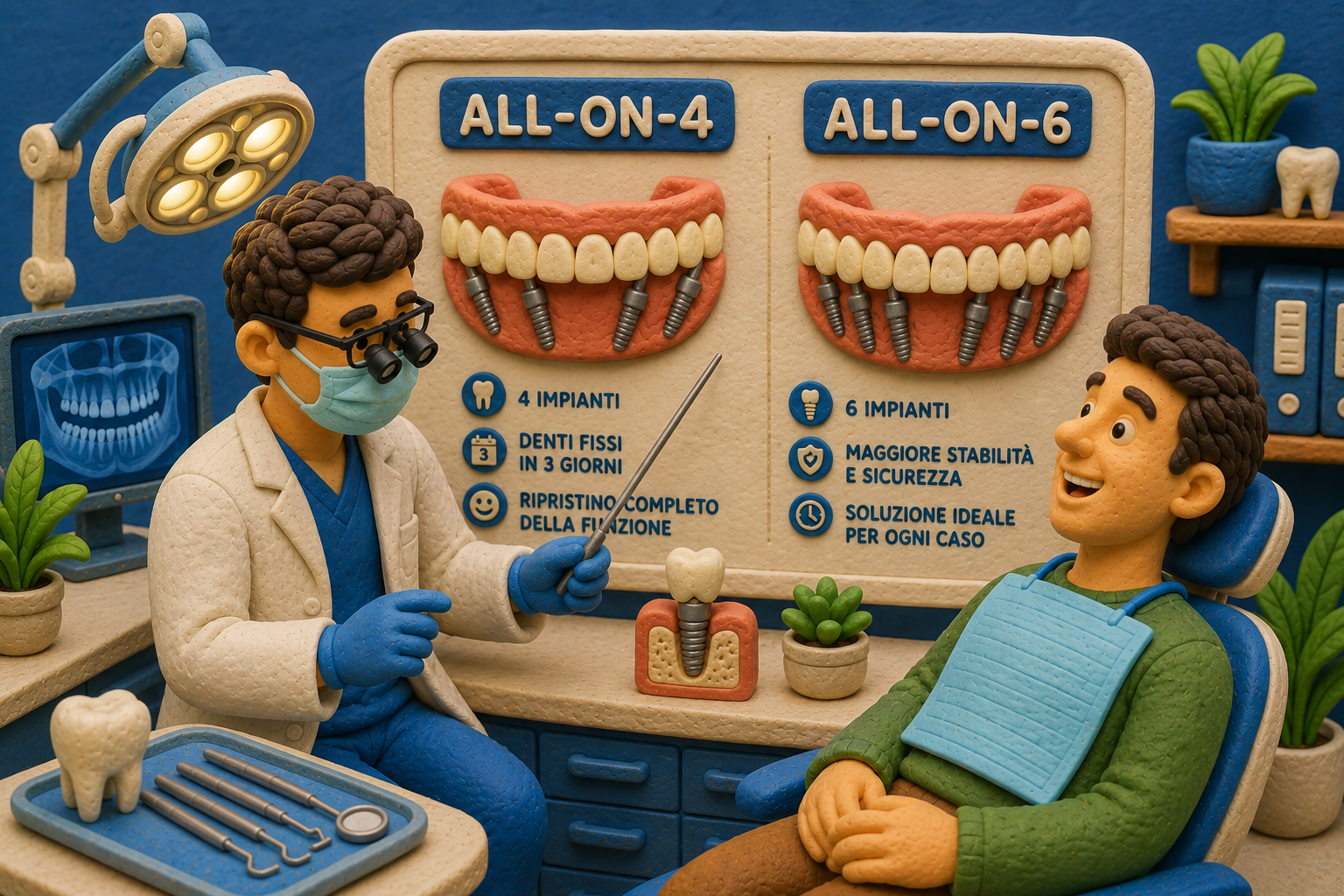
When a patient is missing most or all of the teeth on an arch, All-on-4 and All-on-6 are among the most commonly proposed implant techniques for restoring a fixed set of teeth in a relatively short time. The two names refer to the number of implants used to support an entire arch (4 or 6), and they're often mentioned together as if interchangeable — but the choice between them depends on precise clinical factors, not personal preference.
This guide explains what they are, how they work, what the real differences between the two techniques are, and which questions are worth asking yourself — or asking a clinic — before deciding. It is not a substitute for a specialist consultation: the choice between All-on-4, All-on-6 or another solution is made by a dentist or oral surgeon, after reviewing X-rays, a CT scan and the patient's general health status.
In this article
What All-on-4 is
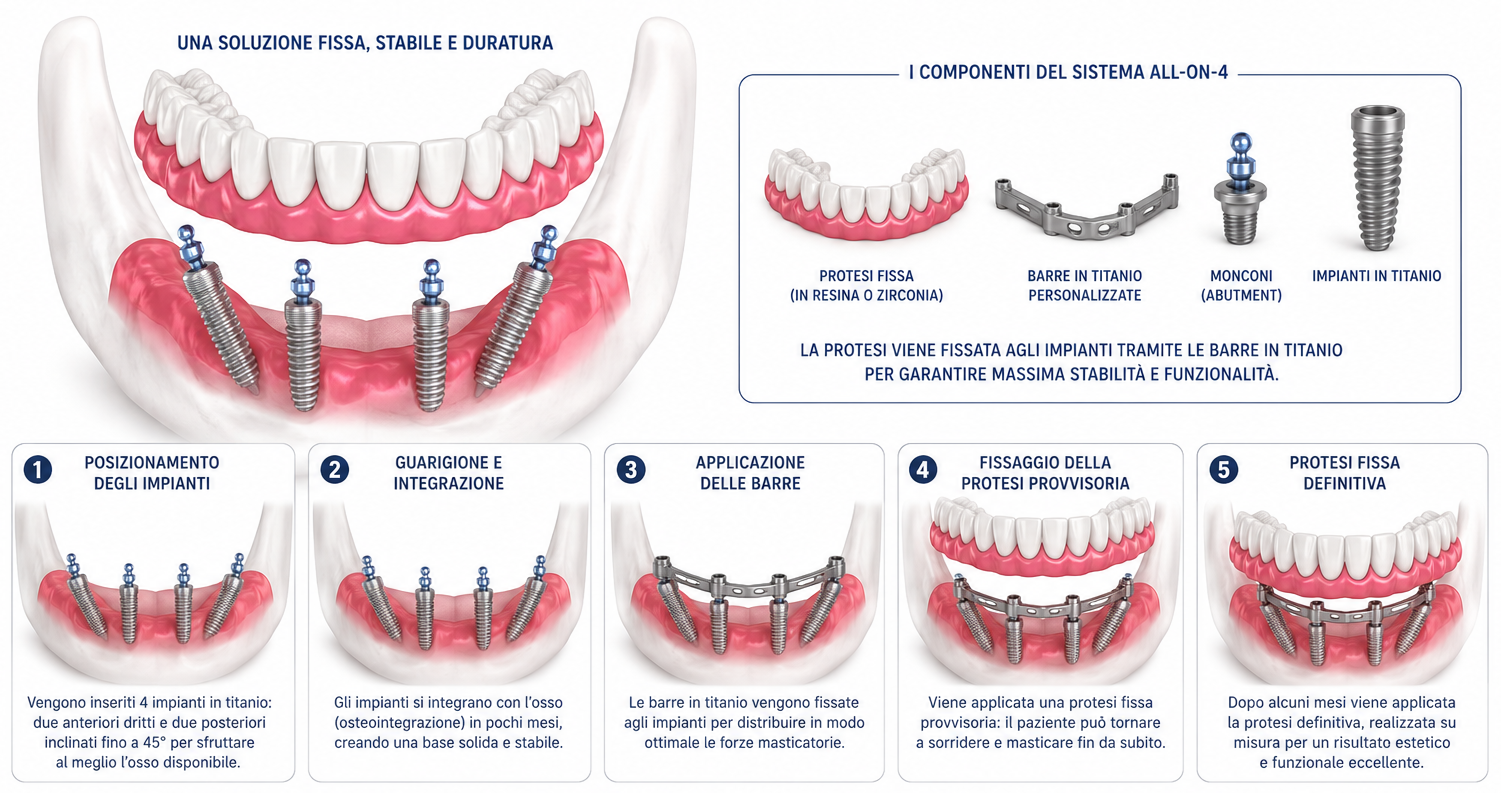
All-on-4 ("all on 4") is the original technique, developed starting in the early 2000s: it involves placing 4 implants per arch — two anterior implants positioned vertically and two posterior implants tilted up to roughly 45° — onto which a full prosthesis is fixed. The tilt of the posterior implants is the key element of the protocol: it allows them to anchor in denser, more available areas of bone, often avoiding a preliminary bone graft even when the remaining bone isn't abundant.
The typical treatment phases
- Implant placement: 4 titanium implants are inserted into the bone — 2 straight anterior implants and 2 tilted posterior implants.
- Healing and integration: over the following months, the implants integrate with the surrounding bone (osseointegration).
- Bar attachment: titanium bars are fixed to the implants to evenly distribute chewing forces.
- Fitting the provisional prosthesis: the patient receives a fixed provisional prosthesis and can go back to smiling and chewing right away.
- Definitive fixed prosthesis: after a few months, the custom-made definitive prosthesis is fitted.
With only 4 implants, surgical time and costs are generally lower than with solutions using more implants, but the safety margin in case an implant is lost is smaller: if one of the 4 implants fails, the stability of the whole structure is at greater risk than with a 6-implant system.
What All-on-6 is
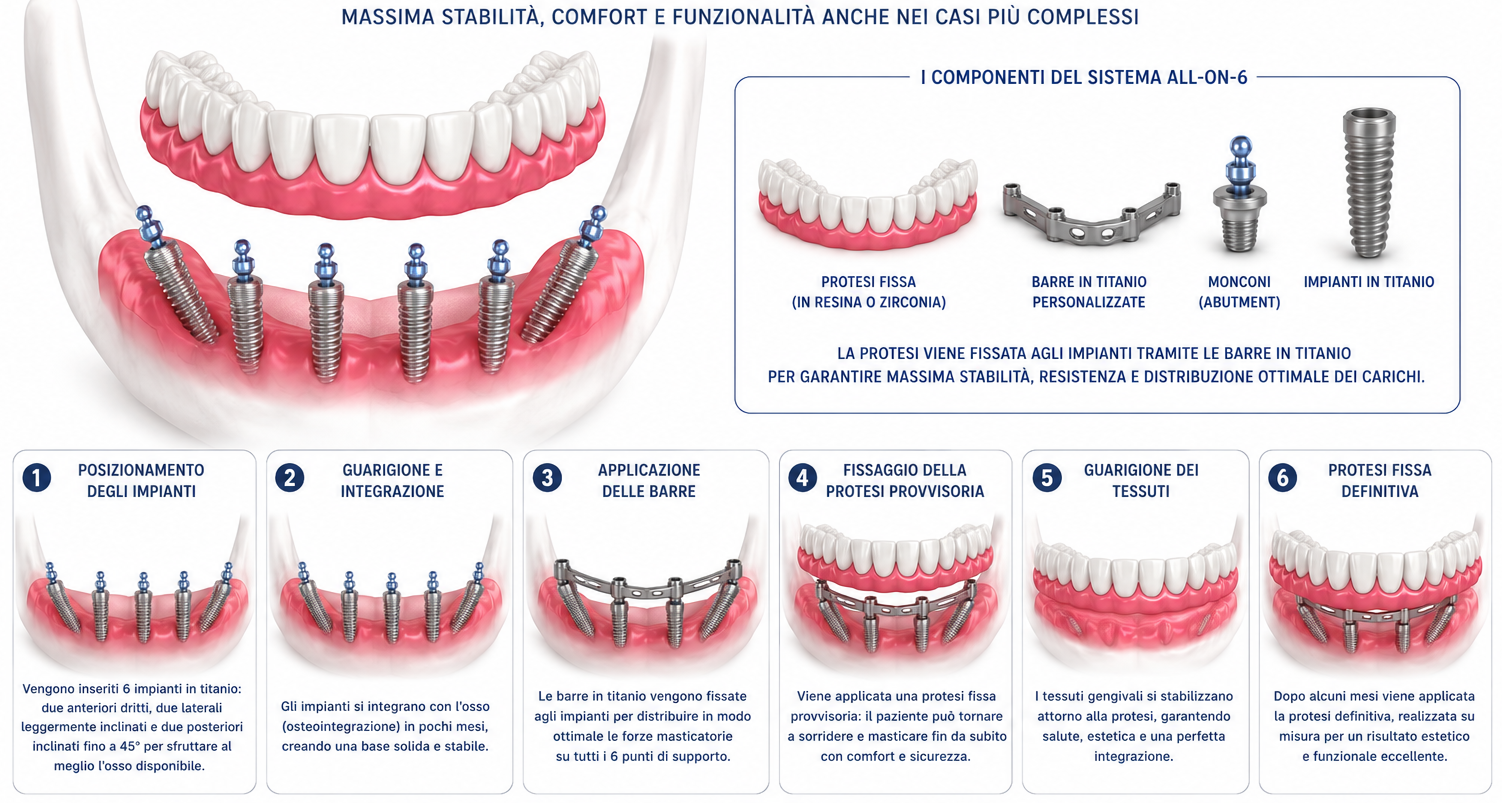
All-on-6 applies the same principle with 6 implants per arch: two straight anterior implants, two slightly tilted lateral implants, and two posterior implants tilted up to 45°, to make the best use of the available bone. Distributing the load over more support points generally makes this technique the preferred choice in more complex cases, where greater stability is needed or where the quality/quantity of the remaining bone is less favorable.
The typical treatment phases
- Implant placement: 6 titanium implants — 2 straight anterior implants, 2 lateral implants and 2 tilted posterior implants.
- Healing and integration: the implants integrate with the bone over a period of several months.
- Bar attachment: titanium bars are fixed across all 6 support points.
- Fitting the provisional prosthesis: a fixed provisional prosthesis, providing comfort and stability from the first few days.
- Tissue healing: the gum tissue stabilizes around the prosthesis, a step that matters more here than with All-on-4 given the larger surface area involved.
- Definitive fixed prosthesis: fitted after a few months, custom-made.
The main advantage is greater structural redundancy: with 6 anchor points, the eventual loss of one implant has a proportionally smaller impact on the overall stability of the prosthesis. The downside is a slightly longer procedure, often a higher cost, and in some cases the need for more available bone at the outset.
The main differences compared
The table below summarizes the most practically relevant differences. These are general indications: the specific case must always be assessed by a dentist or oral surgeon based on imaging.
| Feature | All-on-4 | All-on-6 |
|---|---|---|
| Number of implants | 4 per arch | 6 per arch |
| Bone required | Lower quantity, often sufficient even with moderate bone loss | Generally requires more available bone or better bone quality |
| Need for bone grafting | Often avoidable thanks to the tilt of the posterior implants | Less frequent but not ruled out in cases with very limited bone |
| Load distribution | Across 4 anchor points | Across 6 points: load is more evenly distributed |
| Safety margin (redundancy) | Lower: losing one implant has a bigger impact on the whole structure | Higher: greater tolerance for a single implant failure |
| Approximate surgery duration | Generally shorter | Generally longer (2 additional implants to place) |
| Approximate cost | Usually lower | Usually higher, due to the greater number of implants and components |
| Typical cases | Mild-to-moderate bone loss, priority on shorter time and lower cost | More pronounced bone loss, upper jaw (where bone is often less dense), bruxism or heavy chewing loads |
"More implants" doesn't automatically mean "better"
More implants mean more anchor points, but also a more invasive procedure and a higher cost. All-on-6 isn't automatically the "superior" choice: it's indicated when the clinical situation genuinely calls for it. Be wary of anyone who always proposes the more expensive solution without explaining the clinical reason for it.
When one or the other is indicated
The final decision rests with the clinician, based on imaging (cone-beam CT, panoramic X-rays) and an assessment of overall oral health. Broadly speaking, the factors that weigh into the choice are:
- Quantity and quality of the remaining bone: more available bone with good density makes All-on-4 more feasible without grafts; scarce or heavily resorbed bone more often points toward All-on-6 or a preliminary bone graft.
- Which arch is involved: the upper jaw typically has less dense bone than the lower jaw, which is why All-on-6 is more frequently proposed for the upper arch.
- Bruxism and heavy chewing forces: people who grind their teeth or chew very forcefully may benefit from the greater load distribution offered by All-on-6.
- Available time and budget: given the same clinical indication, All-on-4 generally means a faster procedure and a lower cost.
- The patient's clinical history: smoking, uncontrolled diabetes, bone conditions or previous implant failures are factors the clinician assesses independently of the number of implants chosen, and which may call for dedicated protocols.
It's not unusual for the same person to receive All-on-4 on one arch and All-on-6 on the other: the assessment is made arch by arch, not for the whole mouth as a single block.
Materials and components
Regardless of the number of implants, the system is built from the same basic components, also shown in the single-implant diagram below:
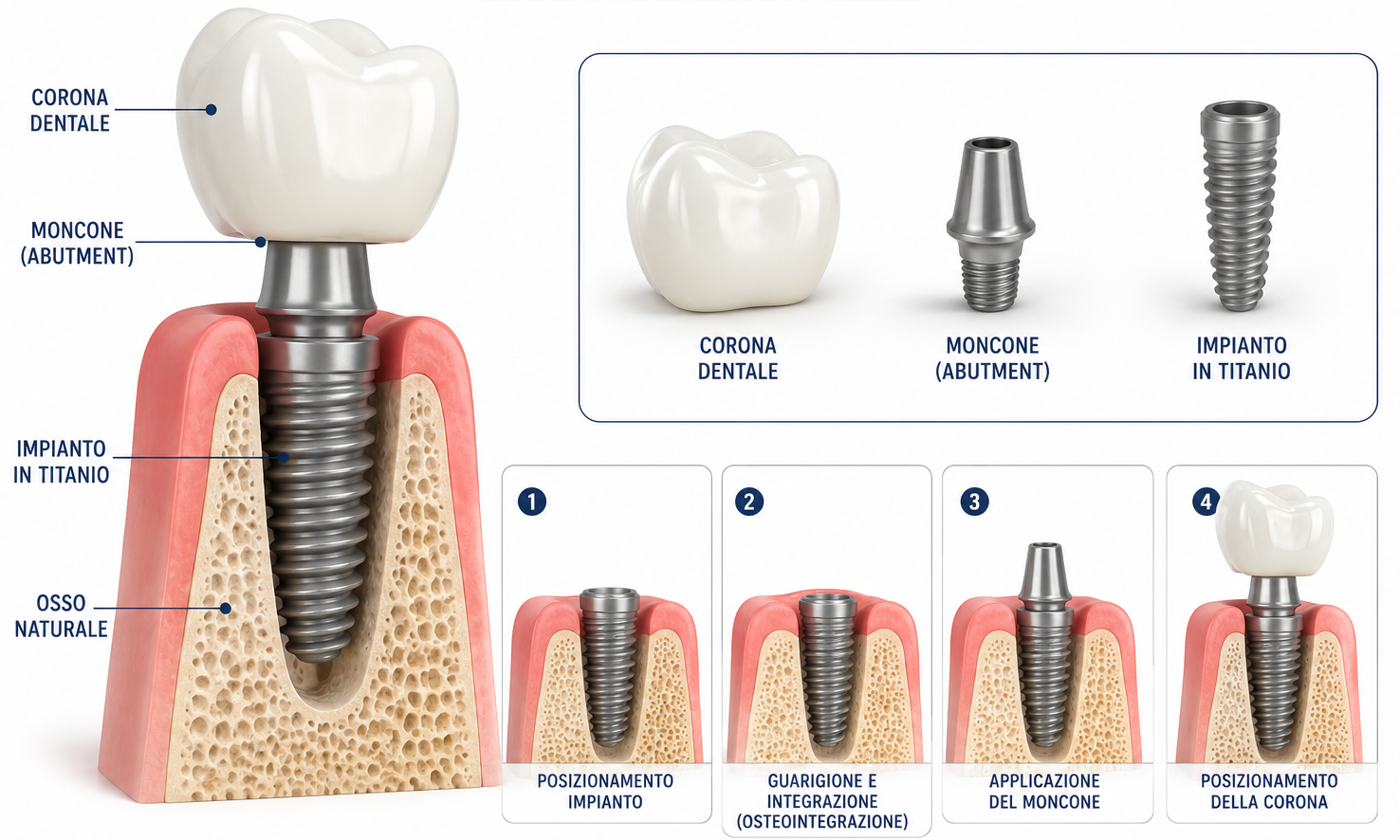
- Titanium implant: the "screw" inserted into the bone, which replaces the root of the natural tooth. Titanium is chosen for its biocompatibility and its ability to osseointegrate.
- Abutment: the connector between the implant and the visible prosthesis, screwed onto the implant after osseointegration.
- Custom titanium bar: milled to measure to connect all the implants together and support the prosthesis rigidly and stably.
- Fixed prosthesis (full arch): made from reinforced resin/acrylic (cheaper, easier to repair, but less durable over time) or zirconia (more expensive, more durable, and generally with a superior aesthetic result closer to natural enamel).
The material of the definitive prosthesis has a significant effect on the final price and should always be specified in writing in the quote — along with the brand and model of the implants used, not just the "type" of treatment (All-on-4 or All-on-6).
Clinical pathway and timeline
Timelines vary from patient to patient, but the pathway generally follows these steps:
| Phase | What happens | Approximate duration |
|---|---|---|
| Consultation and diagnostics | Clinical examination, cone-beam CT, panoramic X-ray, personalized treatment plan | 1 day (often condensed for patients who are traveling) |
| Surgery | Extraction of remaining teeth if needed, implant placement, bar attachment | 1 day (a few hours) |
| Provisional prosthesis | Fitting of a fixed provisional prosthesis: the patient can chew and smile again right away | Same day or within 24-72 hours |
| Osseointegration | The implants fuse biologically with the bone | Roughly 3 to 6 months, varies by patient and arch |
| Definitive prosthesis | Final impressions and fitting of the custom definitive prosthesis | 1-2 appointments after the healing period |
| Follow-up | Periodic check-ups, professional cleaning, checking the stability of the structure | Ongoing, typically annual or twice-yearly |
Anyone traveling for treatment should plan for at least two trips
Even with immediate loading, the provisional prosthesis fitted during the first trip is not the final one. A second trip, a few months later, is needed for the definitive prosthesis. Any quote that mentions "a single trip" for the definitive solution deserves a closer look.
Risks, contraindications and complications
Like any surgical procedure, All-on-4 and All-on-6 carry risks that should be discussed openly with the clinician before proceeding:
- Failed osseointegration: one or more implants may not integrate properly with the bone and may need to be removed or replaced.
- Post-operative infections or peri-implantitis (inflammation of the tissue around the implant) over time, often linked to insufficient oral hygiene.
- Mechanical complications: fracture of the provisional or definitive prosthesis, loosening of the screws, wear of the bar.
- Individual risk factors: smoking, uncontrolled diabetes, osteoporosis treated with certain medications, poor oral hygiene and uncontrolled systemic conditions increase the risk of implant failure.
- Need for revision: in a minority of cases, corrective surgery, or rarely the replacement of one or more implants, may become necessary.
No serious clinic should present these treatments as risk-free: a clinic that downplays or omits these aspects when providing a quote is a warning sign worth paying attention to.
Indicative costs and how to read a quote
Prices vary considerably depending on the country, the clinic, the materials chosen and the number of arches treated. More than the absolute figure, what matters is understanding what's included in the amount quoted. A transparent quote should specify, line by line:
| Item | Why it matters |
|---|---|
| Number and brand of implants | Different brands vary widely in cost, warranty and availability of replacement parts |
| Prosthesis material (resin/acrylic or zirconia) | Affects price, aesthetics and durability over time |
| Any bone grafts or sinus lifts | Often quoted separately: check whether they're already included or added after the CT scan |
| Provisional and definitive prosthesis | Both should be explicitly included, not just the provisional one |
| Number of trips/appointments planned | A second trip means additional travel and accommodation costs |
| Warranty on implants and prosthesis | Duration, conditions and exclusions of the written warranty |
| Handling of any complications | Who covers the cost of corrective treatment, and to what extent |
The lowest quote isn't automatically the best one: a significant price difference compared with other clinics should always be explained (different materials, a different implant brand, fewer check-ups included) before being seen as an advantage.
Questions to ask before choosing a clinic
An essential checklist to bring to a consultation or use during a remote consult:
- Why are you recommending All-on-4 or All-on-6 based on my CT scan, and not the alternative?
- What brand of implants do you use, and is it available outside the clinic's country as well?
- Does the quote include both the provisional and the definitive prosthesis?
- How many trips/appointments are planned in total, and at what intervals?
- What kind of written warranty do you offer on implants and prosthesis, and what does it exclude?
- Who handles any complications once I'm back home?
- Can I speak directly with the surgeon who will perform the procedure, not only with the sales team?